
“I bought these here earlier today, but when I got them home I discovered that one of them seems to have a hole in it.”
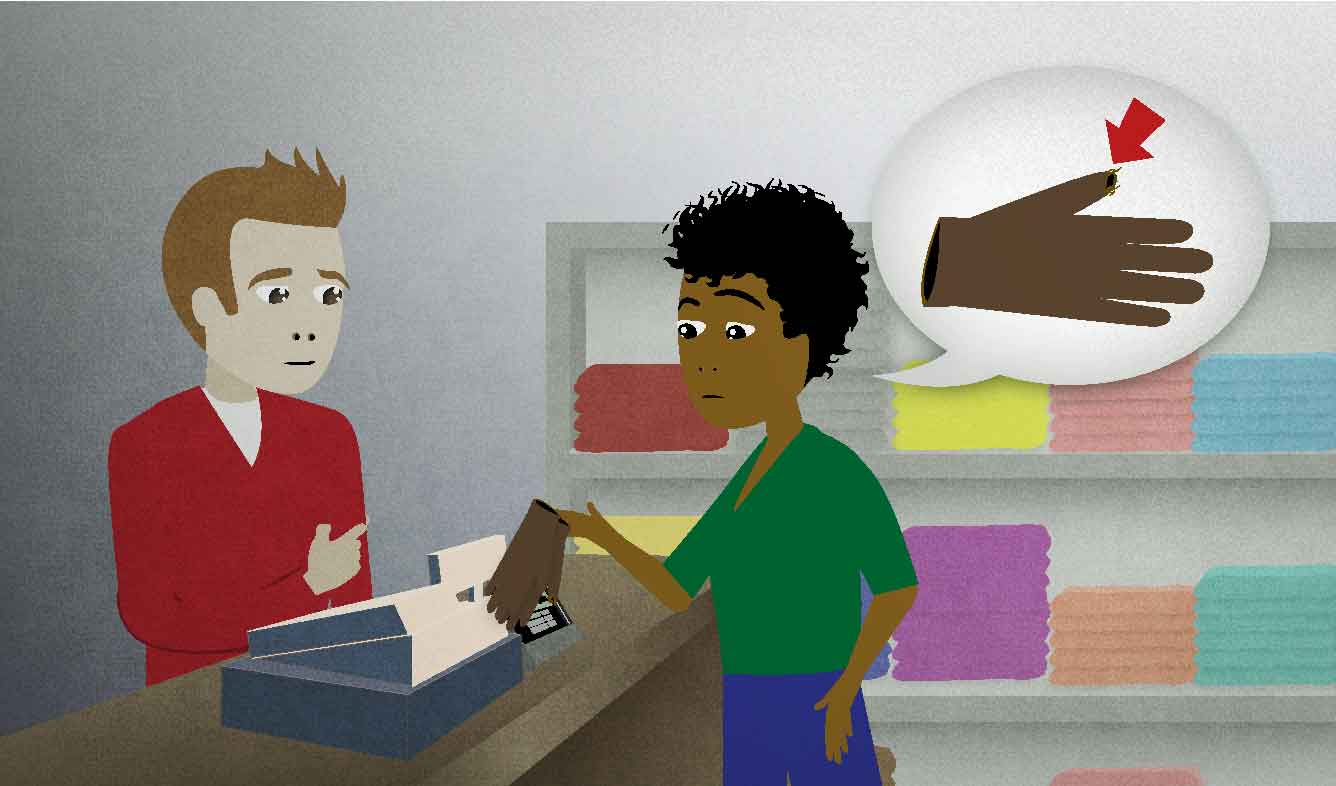
Earlier today you bought a pair of gloves, but one of them had a hole in it. Now you've returned to the store where you bought the gloves. This is how you explain your situation to a cashier on duty.
I bought these here earlier today, but when I got them home I discovered that one of them seems to have a hole in it.
Want Video and Sound? Follow us on YouTube

earlier today
The meaning of "earlier today" is obvious, but you can use this phrase to mean sometime 2-3 hours before now, and within the same day.
get (something) home
When you buy something new, you take it back home with you. To describe this action, use the phrase "get it home":
I can't wait to get it home and try it out!
This phrase is only used for new things that you buy, get as a gift, or are given at work.
(someone) discovered that (clause)
Use the phrase "I discovered that..." to talk about learning something by noticing new details.
This is different from "realizing" something, which also means to start to think something. But "realizing" things takes more mental work than "discovering" things:
As I was riding the train home, I realized that I'd left my keys in the closet at work.
You could also use the word "noticed":
I bought these here earlier today, but when I got them home I noticed that one of them seems to have a hole in it.
(something) seems to (do, have, or be something)
You can say that something "seems to be ___" when you notice something but you're not completely sure that you have identified it correctly. For example, if you're video chatting and it takes her a few extra seconds to answer your questions, you can say:
You can also use "seems to..." to politely point out a problem.
For example, imagine that you're paying for a shirt that you buy at a department store, and you give the cashier some cash. But after he counts it, he says to you:
You seem to be a bit short.
That means "You don't have enough money." But the cashier just says "You seem to be..." to be polite. "Seems to..." is a way to act like you might be wrong about what you've seen or heard, even if you're actually sure that you're correct.