
“I'm just sitting here, watching the bamboo sway back and forth in the breeze.”
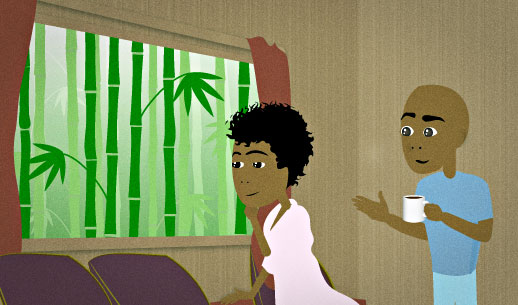
You're on vacation at a resort hotel in Asia. Outside of the window is a beautiful bamboo forest. It's relaxing to look at, so you've been sitting next to the window admiring it. This is what you say when your husband asks what you're doing.
I'm just sitting here, watching the bamboo sway back and forth in the breeze.
Want Video and Sound? Follow us on YouTube

just sitting (somewhere), (doing something)
You can combine "sitting" or "standing" with another action in this way. A few more examples:
I was sitting on the couch doing my homework.
Amy and I were sitting there talking and this guy I know walked by.
They're still standing outside the train station waiting for someone.
Describing an action in this way with "sitting" or "standing" usually makes it sound like the action wasn't very important or interesting. However, it can also sound relaxing, like in the example above. Another example is:
watch (something)I'm just sitting in a cafe, having a cup of coffee. What are you doing?
watch (something)
You generally "watch" things that move, such as:
watching a movie
watching a bird flying through the sky
watching your children play
Read this lesson for a more in-depth explanation of the differences between "watch" and "see":
sway (back and forth) in the breeze
To "sway" means to move back and forth slowly. Here are some examples of "swaying":
- When a couple is dancing together to a slow song, they sway back and forth.
- In a large earthquake, buildings may sway.
- Grass, trees, leaves, etc. sway when the wind blows.
Something that's hanging down doesn't "sway", though; it "swings":
Even after the earthquake stopped, the chandelier kept swinging for several minutes.
You may notice that the word "sway" is often followed by the words "back and forth".
"Sway" is also often followed by "in the wind" or "in the breeze". The word "breeze" means "wind" but sounds very soft and gentle. So if you describe something as "swaying in the breeze", it sounds beautiful and relaxing.
back and forth
"Back and forth" is a common phrase which describes something that goes in two directions. You can use "back and forth" to talk about traveling:
They have an apartment in London and a house in Boston, and just travel back and forth between them every few weeks.
You can also talk about something that swings or sways:
I'm just sitting here, watching the bamboo sway back and forth in the breeze.